Wednesday, January 3, 2007

Do the Republicans need to learn to be more "bipartisan" among themselves?

These two articles give some reason to think so:

Paul Waldman, The GOP's Religious Litmus TomPaine.com 01/03/06:

The conservative coalition, while extraordinarily successful over the past few decades, has always contained the internal tensions that can explode when a period of absolute power is followed by a period of exile.

No time to heal by Sidney Blumenthal Salon 01/03/07:

Ford's [posthumous] condemnation [of the Cheney-Bush Iraq War policies] demonstrated the continued relevance of the contentious politics that enveloped his administration and revealed just how little healing has occurred among the divided Republican elites since Richard Nixon's fall. (my emphasis)

I'm reserving judgment on this until I see a significant bloc of Republicans in Congress outright oppose Cheney and Bush on key votes on important issues.  We've heard predictions for years and years that Wall Street Republicans would soon have it out with the Christian Right/"Main Street" Republicans, but it hasn't happened yet.  The Party factions have united and successfully torn Iraq apart, but not yet the Republican Party.

The last five years, we've heard a lot of talk from Republican "moderates" that sounded nice.  But when it came time to cut legislative deals or vote on bills, they generally capitulated to the White House on the big issues.  Seeing is believing when it comes to "moderate" Republicans.

Tuesday, January 2, 2007

Ford the Healer: Partisan in life, partisan in death?

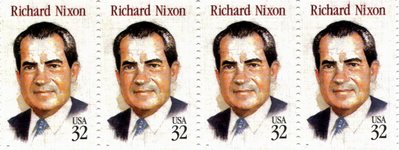
"I'm not a crook": one of Nixon's more famous sayings.

It was a lie, of course. But we're talking about Richard Nixon here. Lying came as natural as breathing to the guy.

Healer-in-Chief Gerald Ford gave him a pre-emptory pardon anyway. The US Postal Service doesn't put someone on a stamp until they are deceased. So I want be surprised to see a stamp of Healer Ford come out later this year with a slogan like, "Healer-in-Chief Ford who heroically pardoned Richard Nixon (who wasn't a crook)".

One reason the ceremonies surrounding the death of a former President are so elaborate is that in the United States, the President is both head of state as well as head of government. Britain and Spain have kings and queens to be head of state, Austria and Germany have Presidents. The head of government is a prime minister. But since the President is head of state (warning: foolish old-fashioned comment coming), I suppose it is somewhat appropriate that his memory be treated somewhat reverentially.

Silly me. The kind of media dysfunction we see on display in the Ford funeral extravaganza is one of many examples of how our "press corps" has virtually collapsed, at least in terms of performing the vital service of a free press in a democracy. Watch closely when Jimmy Carter or Bill Clinton pass away. The pundits will treat them just as reverently, too. [Long pause due to choking and gagging induced by hysterical laughter.]

Republican hack David Brooks, whose commentary I once thought was kind of substantial - I'm willing to admit my mistakes, though in this case I can't explain how I ever came to that conclusion - said on the PBS Newshour Tuesday (Former President Ford Laid to Rest 01/02/07):

And the pardon, which is now universally celebrated, the idea that he could move the country beyond partisanship, that is clearly what a lot of people want. Whether we're going to get there, I'm not sure.

Yeah, "universally celebrated". Except for, uh, all of us who think it was a rotten idea.

Then Brooks went on in the next breath to pimp the Republican Party line of the death, which is those naughty, unruly, uncivil Democrats should be bipartisan, because just like Dear Leader Bush says, the voters said in the 2006 elected that they wanted more bipartisanship. Except for, well, the 75% or so of the public who think we do something to get the hell out of Iraq. And the solid majorities who want things like preservaing Social Security that the Republican Party is dead set against. Other than that, sure, a yearning for more of that sacred bipartisanship was important enough to rank, what, #35 or so on the list of the voters' priorities.

Brooks' regular debating partner is Mark Shields, who I still praise on occasion. I mean, Shields is an honest-to-God liberal. Or at the very least he knows what a liberal is. But he was in Establishment mode tonight, both on that segment and another about incoming Speaker of the House Nancy Pelosi (at this writing, I can only get the audio, Upcoming Congress 01/02/07). He was moaning and groaning about the loss of civility, and making sad puppy-dog eyes reminiscing about the good ole days when there was bipartisan cooperation and yadda, yadda. But he did do a better job discussing Pelosi than Brooks, although that may sound like "damning with faint praise".

Check out those two segments. Although I confess I couldn't sit still to watch all of the second one, it was such a series of sad spasms of horse-poo, snivel-to-the-Party-line commentary I just couldn't get through two whole segments of it at one sitting. And this is public television! Sensible, sophisticated PBS!

I will agree with Shields that that the news feature on Pelosi was well done (Pelosi Set to Become First Female House Speaker 01/02/07.

But Brooks merged the memory of Ford smoothly into the Party line that, golly gee, happens to be the same demand for "bipartisanship" without any serious challenge from Shields. And check out this little bit of pandering to the Christian Right "culture warriors" from Brooks:

This [1976] is eight years after Woodstock. This is after Janis Joplin. This is after Jimi Hendrix. This is about the time of John Travolta and "Saturday Night Fever."

You have to hear the Ford conversation to believe it. It includes an utterly forgettable campaign song from Ford's 1976 campaign with the following deep lyrics:

There's a change that's come over America,
a change that's great to see.
We're going back to work again.
It's better than it used to be.

I'm feeling good about America,
and I feel it everywhere I go.
I'm feeling good about Gerald Ford,
and I'm feeling good about me.

I'm feeling good about Gerald Ford,
and I'm feeling good about me.

How Bruce Springsteen ever competed with talent like that, I will never know.

This is followed by Brooks and Shields gushing over how the hokey campaign song symbolizes the political brilliance for Ford's 1976 campaign. That would be the brilliant campaign that he, uh, lost. The Daily Howler is dead right: if we didn't have a press corps like this, you couldn't invent them.

I mean, these are two of the leading pundits in the country. Genu-ine Big Pundits. And they sat there babbling maniacally about "bipartisanship". Did they sleep through the last five years? Are they not aware that Dick Cheney and George Bush are still in office? Did they take a magic pill that just erased the last five years from their memory? Are they imagine that Cheney and Bush have just transmogrified into cooperative saints? The Unilateral Executive, the torture scandal, the faked evidence about Iraqi WMDs, the total rejection by Cheney and Bush of the Baker Iraq report, Halliburton, Katrina reconstruction corruption, the administration's hardline partisan stances since the election - did a leprechaun just pluck all that out of their skulls for the Tuesday show?

Reality check: the only way the coming two years will be a period of anything other than intense partisanship is if the Democrats roll over and play dead - which we know they are entirely capable of doing. But I don't think they will (Joe Lieberman excepted, of course). Watching Shields and Brooks do their clown show Tuesday made me feel kind of like Linda Blair in The Exorcist, convulsing wildly on the bed and yelling, "Make it stop! Make it stop!"

Our Dear Leader found Ford's Presidency to contain foreshadowings of Our Leader's own Churchillian courage and bold historical vision in his tribute to Healer-in-Chief Ford:

President Ford assumed office at a terrible time in our nation's history. At home, America was divided by political turmoil and wracked by inflation. In Southeast Asia, Saigon fell just nine months into his presidency. Amid all the turmoil, Gerald Ford was a rock of stability. And when he put his hand on his family Bible to take the presidential oath of office, he brought grace to a moment of great doubt.

In a short time, the gentleman from Grand Rapids proved that behind the affability was firm resolve. When a U.S. ship called the Mayaguez was seized by Cambodia, President Ford made the tough decision to send in the Marines - and all the crew members were rescued. He was criticized for signing the Helsinki Accords, yet history has shown that document helped bring down the Soviet Union, as courageous men and women behind the Iron Curtain used it to demand their God-given liberties. Twice assassins attempted to take the life of this good and decent man, yet he refused to curtail his public appearances. And when he thought that the nation needed to put Watergate behind us, he made the tough and decent decision to pardon President Nixon, even though that decision probably cost him the presidential election. (my emphasis)

Someday, historians chronicling the Weimar Republic phase of American democracy will draw a bright red line from Watergate through Ford's pardon to the Iran-Contra affair to the Abu Ghuraib and the other soiled baggage of the Bush administration.

But all this maudlin nonsense about Ford the Healer and how everyone thought Nixon should be forgiven and the lovely dream of bipartisanship if the Democrats would just kindly pretend like the November election never happened ... Make it stop! Make it stop!

Tags: , , , ,

Mississippi and Bush

Now, this is Republican flack Robert Novak speaking, the guy who enabled the outing of CIA officer Valerie Plame for cheap political payback.  But still, it's interesting (A 'Surge' Faces Trouble In the Senate Washington Post 01/01/07):

Even in Mississippi, the reddest of red states, where Bush's approval rating has just inched above 50 percent, Republicans see no public support for more troops.

Is Mississippi really "the reddest [most Republican] of red states"?  I don't have the statistics at hand.  But despite their two reactionary Senators, torture supporter Trent Lott and even more hardcore torture supporter Thad Cochrane, two out of their four Congressional Representatives are Democrats.

An earlier poll this year on the Iraq War showed that opposition was as strong in Southern states as in the country generally.

Tags:

Werwolf

This is a comment I posted, or tried to post, at The Captain's Journal relating to the post Eschatology and Counterterrorism Warfare by Herschel Smith 12/31/06.  But I got a message saying a filter caught it so I'm not sure if it will actually appear there or not.  But here it is.  It deals with an historical issue on the postwar occupation of Germany:

I'm dubious about the claims on the Werewolves made in the last quotation in your post.  The extent of violent resistance in postwar Germany became a current topic in 2003 when Don Rumsfeld and Condi Rice tried to dismiss the growing insurgency in Iraq by comparisons to postwar Germany.  I don't think there's any real-time propaganda stake in the issue today, since it's hard to imagine anyone trying to argue that Germany four years after V-E Day was in a full-blown civil war of the kind going on in Iraq now.

Daniel Benjamin of the Center for Strategic and International Studies, one of the leading American experts on terrorism, argued that Rummy and Condi were wrong on that point in Condi's Phony History by Slate 08/29/03:

Werwolf tales have been a favorite of schlock novels, but the reality bore no resemblance to Iraq today. As Antony Beevor observes in The Fall of Berlin 1945, the Nazis began creating Werwolf as a resistance organization in September 1944. "In theory, the training programmes covered sabotage using tins of Heinz oxtail soup packed with plastic explosive and detonated with captured British time pencils," Beevor writes. "... Werwolf recruits were taught to kill sentries with a slip-knotted garrotte about a metre long or a Walther pistol with silencer. ..."

In practice, Werwolf amounted to next to nothing. The mayor of Aachen was assassinated on March 25, 1945, on Himmler's orders. This was not a nice thing to do, but it happened before the May 7 Nazi surrender at Reims. It's hardly surprising that Berlin sought to undermine the American occupation before the war was over. And as the U.S. Army's official history, The U.S. Army in the Occupation of Germany 1944-1946, points out, the killing was "probably the Werwolf's most sensational achievement."

Healso cites the RAND study  America's Role in Nation-Building: From Germany to Iraq (2003) by James Dobbins RAND Institute, which says:

U.S. officials anticipated and planned to deal with significant residual German resistance following the surrender of its armed forces. Yet no resistance of consequence emerged then or at any time thereafter, much as in Haiti during Operation Uphold Democracy (see Chapter Five). The large number of U.S. and allied military forces in West Germany and the establishment of a strong constabulary force preempted most resistance. Indeed, the constabulary force was specifically created to respond to incidents of civil unrest, conduct mounted and dismounted police patrols, interdict smuggling operations, and aid in intelligence gathering. This contrasts starkly with nation-building efforts in such countries as Bosnia, which were marred by organized crime and civil unrest.

James Carafano at the Heritage Foundation Web site defended the administration's claims against Benjamin's criticisms in A Phony "Phony History" 09/23/03.  He wrote:

What [Benjamin] apparently didn’t bother to do is read Perry Biddiscombe’s "Werwolf! The History of the National Socialist Guerrilla Movement, 1944-1946," which gives full chapter and verse on Nazi-postwar guerrilla operations. It’s true that the Werwolf was poorly organized, and the threat of attacks greatly subsided after a few months of occupation. But they were very real. A survey of records by the U.S. Army Center of Military History shows that at least 39 combat deaths occurred in the first few months of the occupation. If the Nazis had been better organized, the Werwolf might well have given World War II GIs as much trouble as the thugs in Iraq are generating now.

I'm not familiar with Biddiscombe's book and I haven't yet seen a review of it.  I also haven't found the figure of 39 combat deaths he used, but that Military History Center Web site would take a while to search for such a thing.  But this article at the History News Network, So Iraq Is Like Germany? (scroll down), originally at the Web site of radio station WNYC 08/29/03, quotes Biddiscombe himself from an interview:

But according to Perry Biddiscombe, a historian of postwar Germany who wrote a 1998 book on the Werewolves, the force was designed only to assist the German army in winning the war. It was not created to be an underground movement after a German defeat.

As a result, Biddiscombe said, Rice is correct that the Werewolves attacked U.S. troops -- but the only documented assaults took place before the Nazis capitulated on May 7, 1945.

"After the end of the war there's a lot more ambiguity," said Biddiscombe, who teaches European history at the University of Victoria in British Columbia, Canada.

One reason for that ambiguity is that a few days before the Nazi surrender, the SS officially disbanded the Werewolves. But in the last month of the war, as Germany collapsed, Nazi radio propaganda called on Germans to take up arms to resist the occupying forces. Members of the Hitler Youth vowed to join the Werewolves in attacking Allied troops, and some other Germans who resisted after the surrender adopted the term "Werewolves" to describe themselves.

I wasn't able to locate the original source or author of the last quote in your post.  A search for the name of Gen. Berzarin turned up many references apparently quoting from a passage used in a post by the Wall Street Journal's James Tarantino, "General N.E. Berzarin, who was rumoured to have been waylaid..."

But Tarantino didn't give the author or the name of the article and linked only to the general Web site of History Today, and I couldn't find the article in a search on their Web site.

I'm curious now about Biddiscombe's book and also about the "explosion in the Bremen police headquarters ... in June 1945, [that] killed five Americans and thirty-nine Germans".  I don't recall coming across that before.

I know that there was considerable lawlessness in German cities in the months following V-E Day, particularly by roving gangs of young people.  But if that Bremen explosion occurred and was the work of anti-Allied resistence fighters, that would be easily the most significant of such actions I ever heard of.

Review of "The Specter of Munich" by Jeffrey Record

Jeffrey Record's The Specter of Munich: Reconsidering the Lessons of Appeasing Hitler (2007) is an expansion of his August 2005 paper for the US Army's Strategic Studies Institute (SSI), Appeasement Reconsidered: Investigating the Mythology of the 1930s. I reviewed that paper in October 2006. The Specter of Munich contains much the same material in the historical analysis of the appeasement policy of Britain and France. So I'll focus here more on the additional material in the book which applies some observations from his analysis to the current US situation, especially in the Iraq War.

As I described in more detail in the earlier review, Record makes clear that the appeasement policy was a disastrous strategic mistake. But that mistake is popularly understood today as a failure by Neville Chamberlain in a mano a mano testosterone face-off with Adolf Hitler at the Munich Conference in 1938. The popular understanding seems to have been shared by many senior policymakers in the decades since the Second World War. But, in fact, the mistakes in the appeasement policy were not primarily personality failings on the part of Chamberlain or of French Prime Minister Edouard Daladier.

For instance, France's foreign policy was based on a series of forward alliances with Czechoslovakia and Russia against Germany; but their military policy was a defensive one not suited to supporting allied nations in the east by attacking Germany if they came under German attack. Britain assumed that airpower would be decisive in the war but also had mistaken assumptions about the effectiveness of air power and also poor intelligence on actual German air power capabilities. Britain's policy was based on a widespread British belief that the Versailles Treaty that had ended the Great War (First World War) was excessively harsh on Germany, while France insisted on enforcement of the Versailles Treaty but doing so with a military strategy not suited to enforcing it. And this is only part of the list.

The main additions in the book compared to the paper have to do with how the lessons of appeasement from the 1930s have been applied to influence policy, and what more constructive lessons might be. For instance, in an expansion on the material at the end of p. 43 in the SSI paper, he writes of Richard "Prince of Darkness" Perle, generally referred to as the "leading" neoconservative:

Given the horrors of that war, initiation of a preventive war seems retrospectively imperative, and when neoconservatives such as Richard Perle speak about how Hitler could and should have been stopped before 1939, they mean via forcible regime change of precisely the kind the United States launched against Iraq in 2003. But it is here that the neoconservatives enter the fantasy realm of historical counterfactualism. For Britain and France in the 1930s, a decisive preventive war against Germany was morally unacceptable, politically impossible, and militarily infeasible. Rewriting history is always easier than writing it. If Chamberlain horribly misread Hitler, the neoconservative indictment of Chamberlain conveniently assumes that the option of preventive war against Germany was as available to London and Paris in 1938 as it was to the United States against Iraq in 2003.

The American experience in Iraq testifies to the perils inherent in forcible regime change, especially forcible regime change undertaken on the basis of rosy neoconservative assumptions about the degree of difficulty involved and without adequate preparation for the possibility of postregime violence and the challenges of national political and economic reconstruction. Yet one can speculate that the magnitude of the task of forcible regime change in Germany in, say, 1938 would have dwarfed that in Iraq today. Hitler was a genuinely popular leader within Germany, whereas Saddam Hussein was detested by all but the minority Sunni Arab population. Germany in 1938 had a burgeoning economy and a rapidly expanding and highly competitive military establishment, which could have been counted upon to offer much more formidable resistance than Saddam's sanction-crippled forces. An effective occupation and reconstruction of Germany would in any event have required far more manpower, resources, and time than the United States has been prepared to invest in Iraq. (my emphasis)

Record emphasizes repeatedly throughout the book that in evaluating the decisions made by British and French officials, we have to keep in mind that they didn't know they were making pre-Second World War decisions. They were trying to avoid a war.

The bulk of the additional material in the book come in the last two chapters, where he looks in particular at the lessons he would draw for the United States today from the appeasement experience of the 1930s. He formulates the major lessons he sees as follows:

* "Don't propitiate an insatiable great power dictator if you are in a position to pursue and alternative policy" - but rely on reality-based evaluations of when the opponent is "insatiable".

* "[T]hreat miscalculation can have severe penalties". The popular version of the "lessons of Munich" recognizes that underestimating threats can be dangerous. But part of the Anglo-French miscalculation in the 1930s was overestimating German air power - even neocon idol Winston Churchill did that.

* "[D]emocratic governments are constrained by public opinion", both in a policy of initating war and in sustaining public support in a protracted war. He expands on this as follows:

Leaders of democratic states must necessarily consider public opinion in making decisions to use (or not use) force. They can and do attempt to mobilize public opinion for war, but in the end they cannot readily march off to major war - or continue to sustain a policy of war - in the face of a hostile electorate. This is especially the case in wars of choice as opposed to wars of necessity. (my emphasis)

* Take account of "the risks inherent in discordance between foreign policy aims and military force posture".

* Be aware of the "dangers of strategic overextension". This can be done either by boosting the resources devoted to the strategic goals, or by scaling back on those goals (or of course some combination of the two). Clarity in the way a nation defines threats is an important component of this.

* It is important to maintain "a proper offensive-defensive balance".

* Maintain as much as possible "consistency in threatening and using force".

Record discusses these lessons extensively in the context of the Iraq War and the current assumptions of military "transformation", which has focused on developing more high-tech capabilities relying even more on air power. It could be argued that Record's usage of his "lessons of Munich" to frame his own criticisms of the Iraq War can lead to the same kind of reading current experiences back into one's evaluation of historical events.

It's certainly easy to fall into that. I would argue that Record does not do so in this case because he uses those broad lesson categories to examine aspects of our current situation in terms of realistic analysis of the current situation. Where American statecraft (which seems an awfully highfalutin word to apply to the cynical operations of the Cheney-Bush administration, I know) has so often gone wrong is to try to make every enemy we face be the new Adolf Hitler and every war as critical to American security as the confrontation over Czechoslovakia in 1938 proved to be for the world.

This is a rich chapter, almost any paragraph of which could be the basis of extensive discussion and debate. Here, I'll mention just a few. On the subject of threat miscalculation he writes:

War is the province of miscalculation. History is littered with wars arising from misperceived enemy intentions, capabilities, or both, and this reality seems endemic in the practice of statecraft. Just as Chamberlain misread Hitler's intentions in 1938, Hitler misread British intentions in 1939. In Korea in 1950, the Soviets misread the intentions of the Americans, who in turn misread the intentions (and capabilities) of the Chinese. In Vietnam, the United States overestimated its own capabilities and underestimated those of the Communists. And Saddam Hussein misread George H. W. Bush's intentions in the Persian Gulf in 1990-91, while the George W. Bush administration misread Saddam Hussein's capabilities as it approached America's second war against Iraq in 2003. Saddam certainly wanted deliverable weapons of mass destruction (WMD), but wanting is not the same thing as having.

On the mismatch between foreign and military policies:

The fatal misfit between France's foreign and defense policies finds no analog with the United States today. ...

That said, however, there is a discernible and growing disjointbetween the kind of war the United States prepares to fight and the kinds of wars it has actually fought. To put it another way, U.S. military force posture is increasingly at odds with the emerging strategic environment. The United States remains focused on preparation for high-technology conventional warfare against other potential military peer competitors (most notably China), whereas the predominant threats to its security interests are rogue states, failed states, and nonstate unconventional adversaries practicing asymmetrical war. This new threat environment places a premium on preparation for operations other than war (OOTW)- that is, operations other than the big conventional force-on-force mission for which the U.S. military is optimized. Such operations include peace enforcement, counterinsurgency, stability, and state-building operations. Success in performing these operations is certainly essential to a foreign policy that embraces forcible regime change in places like Iraq and the muscular promotion of democracy in the Arab world and other regions of political autocracy and economic stagnation. (my emphasis)

He believes that the institutional resistance to shifting the focus of the US military from conventional war preparation to OOTW is extremely strong, especially in the Army: "Unfortunately, whatever the strength of the arguments for establishment of OOTW-dedicated ground forces (and there are serious arguments against), such forces stand little bureacratic chance of ever seeing the light of day."

But he doesn't use this as a shrug of the shoulders to say there's no point in worrying about changing it:

None of this is to argue that the Defense Department is hopelessly unadaptable to the deconventionalized global strategic environment - only that its force structural bias toward conventional combat is long standing and well entrenched and that overcoming that bias will entail fundamental changes in how U.S. military forces are organized, equipped, trained, and manned. For example, personnel policies that constantly rotate individuals from one assignment to another and promotion polices prejudiced against development of specialized area knowledge and linguistic skills are antithetical to the requirements of successful counterinsurgency. For another example, retention of division-level organizations makes little sense against decentralized, irregular adversaries. And what does the F/A-22 program [one of the Pentagon's most controversial] bring to the table in the fight against al Qaeda? (my emphasis)

Yes, Jeffrey Record, a professor at the US Air Force Air War College, is questioning the current policies of our infallible generals. Fortunately, these kinds of issues are discussed within the military, often more freely it seems than among our punditocracy. But maybe our punditocracy is a poor comparison to any kind of serious discussion of such matters.

And, on the question of realistic threat definition, he writes:

The argument that the war in Iraq serves as a magnet for terrorists that otherwise would be conducting attacks in the United States is not persuasive. The war certainly did not prevent the Madrid and London attacks. Iraqis are notable for their scarcity among the ranks of Islamic terrorists, and 90 to 95 percent of insurgents in Iraq are Iraqis radicalized by the dispossession of the Baathist regime and/or the U.S. invasion and occupation of their country. True, most suicide bombings in Iraq have been conducted by outsiders - mostly Saudis, Syrians, and Kuwaitis - but studies of suicide bombers in Iraq by the Saudi government and an Israeli think tank reveal that the great majority of them had never taken part in any terrorist activity before their arrival in Iraq but rather were radicalized by the Iraq War itself.  They are part of a new generation of terrorists responding to calls by Osama bin Laden and radical Islamic clerics to defend their fellow Muslims from the "infidel crusaders" in Iraq. Notes terrorism expert Peter Bergen, "The president is right that Iraq is a main front in the war on terrorism, but this is a front we created." (my emphasis)

The final chapter includes a more extensive set of "observations and recommendations" than his SSI paper. He gives 11 of these, and here are his one-sentence summaries of them:

1. Nazi Germany remains without equal as a state threat.

2. American presidents should cease invocation of the Munich analogy to justiy threatened or actual uses of force.

3. Today's strategic environment bears little analogy to that ofthe 1930s.

4. Osama bin Laden and Adolf Hitler share key traits.

5. British and French security choices in the 1930s were neither simple nor obvious.

6. Hindsight is not 20/20 vision; it distorts.

7. The United States is poorly served by reliance on preventive war as a means of dealing with states it fears or simply does not like.

8. Political-military coordination is essential to effective statecraft, particularly in overseas state building.

9. The prevalence of operations other than warfare (OOTW) over conventional military operations in the post-Soviet world argues strongly for the creation of OOTW-dedicated U.S. military forces.

10. A significant increase in the size of U.S. ground forces is in order.

11. A new and comprehensive assessment of the state of U.S. homeland security is also in order.

While I'm generally in agreement with Record's analysis, I would oppose any increase in US ground forces until Congress conducts a real review of US foreign policy. If we don't have enough ground forces to enable a policy of preventive war to be implemented like Cheney and Bush did in Iraq, that is a good thing. If a shortage of soldiers prevents them from attacking Iran this year - which it should, though that's scarcely the only reason not to attack Iran - that is also a good thing. Force composition can never stop a reckless or criminal Executive from making bad decisions on use of force. But the current official foreign policy of the United States under the Bush Doctrine is one of preventive war. I'm opposed to adding any more ground forces as long as such a destructive and wrong strategic doctrine is official US policy.

I'll close with this quote from Record's elaboration of his second point in the concluding chapter, that Presidents should just stop using the Munich analogy to justify wars:

Robert Merry properly observes that the word "appeasement" carries "a lot of historical freight, given that for decades it has described the soft and accommodative policies of Britain's Neville Chamberlain toward Adolf Hitler in the 1930s. Thus it suggests that if we don't get tough with any particular regional power, we are going to have another Hitler on our hands." Merry also rightly warns, however, that "not every regional power with national ambitions constitutes a threat to world peace (although it might to American hegemony), and in fact policies based on that assumption are likely to be more destabilizing to peace than such countries themselves." As a strategic threat, Saddam Hussein was hardly Adolf Hitler. Indeed, if anything good can be said about Saddam Hussein, perhaps it is that he did not permit Iraq to degenerate into the world's primary recruiting and training ground for Islamic terrorism. (my emphasis)

Altogether, Record's book is a very worthwhile analysis of a major political and diplomatic turning point leading to the Second World War, and it contains some refreshing and sensible analysis about the Iraq War. It goes without saying that the current administration will ignore the latter. But Congress should pay attention to these kinds of criticisms.

Tags: , , , , , ,

Monday, January 1, 2007

Lynch-murder 2006

What we saw with the execution of Saddam - literally saw, thanks to the miracles of cell-phone photography and the Internet - was a lynching.  I was about to say it was under a thin cover of law, but that would be silly.  Even a dictatorship should be embarassed about as flimsy a show of a trial as that one was.  It's a genuine disgrace to America.

It was a lynching, complete with hooting, hostile enemies carrying out the deeds in the black masks of a death squad.  I'm surprised they didn't torture him with an electric drill first.  At least we haven't heard of such a thing yet; it really won't surprise me if we do.

Digby writes, "Saddam Hussein is the [one] man I would have thought was least likely to be turned into a martyr, but damned if they didn't manage to do it. Bush's Law."

Green Greenwald summarizes the disgrace aptly:

As Chris Floyd notes, many of the "facts" reported by the Times article are almost certainly rank fiction emanating from the White House with the intent of distancing itself from this grotesque affair - hence, all of the oh-so-concerned Bush officials oh-so-worried about the need to adhere to legal constraints, urging the Iraqis to slow down and carry out the execution in a dignified, orderly and legal manner, and consenting only because the Iraqis asserted the prerogatives of their sovereignty.

But as Floyd also correctly observes, Saddam was in U.S. custody until the very last minute, and both the fact and the terms of the execution required the approval of Bush officials, which they gave - implicitly, if not explicitly, by handing over Saddam for his middle-of-the-night noose fitting. Comparisons to the relatively dignified and orderly Nuremburg executions only serve to highlight how far America has tumbled under this administration, on every level that matters.

So this is the grand and noble achievement which the President and his band of bloodthirsty followers are reduced to celebrating - a lawless, thugish hanging, carried out in clear and deliberate violation of the law, by a bunch of homicidal street thugs and militia foot soldiers who themselves will be included among our next kill targets once our glorious "sustained surge" begins.

Review of Peace Not Apartheid by Jimmy Carter

Jimmy Carter's controversial new book Palestine: Peace Not Apartheid (2006) spells out the major issues involved in the Israel-Palestine conflict in language accessible to the average newspaper reader. In other words, the reader doesn't have to navigate philosophical discussions about "realism" vs. "internationalism" vs. "neoconservatism".

But he does manage to define the issues well and put them into their diplomatic context since the Six Day War of 1967. The book has a handy 10-page chronology in the beginning, maps illustrating peace propossals and the political situation at various points, and in the and in the app-endices the texts of UN Resolutions 242 (1967), 338 (1973) and 465 (1980), the text of the 1978 Camp David Accords and other key diplomatic documents.

This may sound ike something only a libararian or a professor of diplomatic history could love. Or even stay awake to read. Instead, what Carter does here is to provide a kind of handbook that anyone literate in English can use as a reference when confronted with news references to various agreements and historical events. Most importantly, he demystifies the Israel-Palestine conflict. He presents not a struggle of eons based on irreconcilable hatreds, or a hopelessly complex tangle of issues only a diplomat could decipher. He presents a political conflict that can be resolved to the great benefit of both sides.

The basic issues are well-known: Palestinian and Arab government recognition of Israel in its 1949-67 borders; a genuinely sovereign Palestinian state; withdrawal of the Israeli settlements in the West Bank; the Palestinian "right of return"; a resolution of the status of Jerusalem with general access to the holy places of Islam, Judaism and Christianity; an end to violence as a regular political tool on all sides.

There are problems in the details, of course.  But the basic problem is to achieve the will on all sides to settle the issues, especially Israelis and Palestinians.  And the current Israeli policy of expanding settlements in the West Bank while building a "security wall" that carves up Palestinian territory makes a permanent peace progressively more difficult to achieve.  As Carter's book makes clear, the current Westn Bank policy is not likely to impose the peace of a prison on the Palestinias, but to prolong violent conflict indefinitely.

Having read the book, I'm a bit puzzled at some of the reactions I've seen.  Sure, he criticizes the positions of Israeli hardliners and the current government.  But his criticisms are sound.  And the United States has a great interest in seeing the Israel-Palestine conflict peacefully resolved, as the Baker-Hamilton Iraq Study Group report emphasized.

The Los Angeles Times reports on new settlement activity in West Bank housing OKd by Richard Boudreaux 12/27/06:

Israel has approved construction of new housing for Jewish settlers in the West Bank, officials said Tuesday, drawing protests from Palestinian leaders and Israeli peace activists who said the decision violated a 3-year-old pledge to the United States to freeze settlement activity.

Israeli officials insisted that there was no such breach, saying the site of the new homes for 100 families in the northern Jordan Valley had been a Jewish settlement since 1981. But Palestinian leaders said the announcement, coming just three days after Israeli Prime Minister Ehud Olmert and Palestinian Authority President Mahmoud Abbas launched an effort to revive peace talks, undermined the cooperative spirit of the weekend meeting. ...

Yariv Oppenheimer, director general of Peace Now, disagreed. "They're effectively establishing a new community," he said. "It's a violation of the road map accord."

The settlements are also illegal under international law because settlements are forbidden in occupied territories. And Israel itself officially recognizes the West Bank as occupied territory. It's exactly stories like this for which Carter's book could be a handy reference for newspaper readers.

Tags: , , ,