Thursday, May 3, 2007

The more I see this kind of thing, the more disturbing it gets

"It" in this case being the notion that our invincible generals can only lose a war if the wimpy civilian politicians at home lose their Will and Resolve and Determination and other manly characteristics. This example comes from the May-June 2007 issue of the Army's Military Review, Discouraging Hearts and Minds: Democracies and Insurgencies by Major Erik Claessen of the Belgian Armed Forces.

To start with, can anyone explain to me how this perspective is compatable with democracy? Claessen writes:


Coercing the counterinsurgent’s democratic government to embrace an exit strategy requires the ability to influence the mainstream opinion of the counterinsurgent’s electorate. ...

A discouraged electorate can be devastating for the democratic counterinsurgent, akin to destruction of his armed forces.
(my emphasis)
No, a "discouraged" electorate who demands changes in war policies through their elected representatives are doing what citizens in democracies are supposed to do, determining their government's politicies. To put it in the most basic Democracy 101 terms, the bottom line is the people and their representatives decides the foreign policy: the military's job is to implement it.

I've seen this kind of argument so much now I'm picking up on some trends. There's a rhetorical trick involved with most examples of it, including Claessen's: treat public relations factors as though they were pseudo-neutral technical considerations. This obscures the fundamentally Cheneyesque nature of this idea, which is that the people should do what the Leader says and shut the hell up about it, except when they're cheering.

In the end, Claessen's magic solution is also Cheneyesque. He says you should just keep the war secret and encourage the media to focus on other things. I think the Soviet Union followed that policy in their Afghanistan War, and that worked out brilliantly, didn't it? And, besides, if you can keep journalists out of the war zone, so much the better. Claessen actually writes, and Military Review actually published, "Given that heroes are in short supply in every profession, it is logical that journalists prefer to report on missing American girls in Aaruba rather than on a counterinsurgency in a country where they risk injury or death [by covering a war]."

Postmodern warfare: it's all PR. The word "Iraq" does not appear in Claessen's article. But he would have us believe that if the government had just promoted more missing-white-girl stories, that most of us just wouldn't have noticed there was a war going on in Iraq. And we're giving half the military budgets of the entire world to people who take stuff like this seriously?

Tags:

Ouch!

The military Stars and Stripes newspaper often features some from letters to the editor. In the 05/03/07 European and Mideast editions, a civilian contractor currently serving in Iraq, Landon Valentine, writes about Outspoken retired generals:
What I am referring to is the recent spate of retired general officers who suddenly have the candor and courage to step up to the plate and say what they really feel.

The trend seems to have begun, when retired Maj. Gen. Paul Eaton and six comrades began to beat their drum about former Secretary of Defense Donald Rumsfeld. The war was being ran incorrectly, the secretary wouldn’t listen to his officers, and the list went on.

Where were Eaton and company with all their courage and candor when they were still actively serving? ...

They all had their eyes on the next star — for their epaulets — and were content to let things go, as long as things went favorably for them.

And if I am incorrect, then what could’ve been the motive for their silence, knowing soldiers were dying unnecessarily? Knowing that there was a problem with the way the war was being ran, and soldiers were paying in blood, they kept their mouths shut to protect their careers.

I think the point is clear. They sent their men knowingly into harm’s way, and only found courage, when they knew they were safe from retribution. (my emphasis)
Like I said, ouch!

Tags:

Fantasy and reality

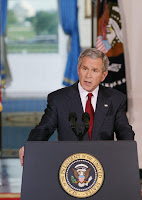
Our Leader celebrating National Prayer Day with Shirley Dobson, wife of James Dobson who is generally considered the most influential Christian Right leader in the US

The exceptionally talented Australian singer-songwriter Paul Kelly has a song called, "The Pretty Place". The narrator in the song talks about how when he gets fed up with the frustrations of life, he goes to "the pretty place"; it's never clear in the song whether it's an actual location or some sort of fantasy relaxation.

It seems that the image of Iraq in Bush's head is his own "pretty place", definitely of the fantasy variety. Bush,
President Bush Discusses War on Terror, Economy with Associated General Contractors of America 05/02/07:


Al Qaeda has pursued their objective with a ruthless campaign of violence. ... And not long ago, it looked like they might prevail in Anbar - looked pretty grim, it really did. Then something began to change, because we were steadfast, because our troops and our diplomats are courageous people. Tribal sheikhs finally said, enough is enough. The local leaders said, we're tired of it. And they joined the fight against al Qaeda.

The sheikhs and their followers knew exactly who the terrorists were, and they began to provide highly specific intelligence to American and Iraqi forces. ... And so they began to provide intelligence, all aiming to secure their part of Iraq so they could live in peace.

They began to encourage their young men to volunteer for the security forces. The number of Iraqi army and police recruits in Anbar has skyrocketed. It's an interesting measurement, isn't it? There's a threat to the security of their people, the local leader said, why don't you join up to help defend us, and the number of recruits is significant.
Patrick Cockburn, reporting on the still-unconfirmed death on an Al Qaida leader in Iraq, Insurgents reported to have killed al-Qa'ida commander Independent 05/02/07:


The US and the Iraqi government have been trying to encourage a breach between al-Qa'ida and other insurgents for almost as long as the four-year-old war has lasted. So far, there has been little sign of success. There is the additional problem that anti al-Qa'ida Sunni groups are often equally anti-American. (my emphasis)
Otherwise, Mrs. Lincoln, how did you like the play?

Tags:

Wednesday, May 2, 2007

The illusory promise of high-tech firepower


What were their names, tell me what were their names
Did you have a friend on the good Reuben James
What were their names, tell me what were their names
The men that went down on the good Reuben James


(Woody Guthrie, "The Sinking of the Reuben James")
Helena Cobban, one of the bloggers genuinely well-informed about Middle East affairs that we're lucky lucky to have posting on a regular basis in her Just World News blog, has posted a review, Boys with (very lethal) toys: What are these 'toys' good for? 05/01/07, of the paper The Limitations of Standoff Firepower-Based Operations: On Standoff Warfare, Maneuver, and Decision by Ron Tira. Tira analyzes the Israeli military doctrine of "standoff, firepower-based operations" (SFO's); as Cobban writes, "the Israeli concept of reliance on SFO's is intimately - one might say, organically - linked to many of the ideas and concepts developed within the US military in recent years". Actually, Israeli military theories and practices have been very influential on the US military since the Six Day War in 1967, so there's nothing especially controversial about her observation.

Basically, the concept is the hope-burns-eternal one of finding the magic bullet, the Super Weapon, the technological fix that will make Our Side invincible. It involves the idea that air power and high-tech artillery can win wars while minimizing own-side casualties.

There's nothing new about the search for the Super Weapon, of course. And the gee-whiz admiration for the latest technologies of death is always a point of enthusiastic comment at the beginning of a war. What Cobban discusses in her post is that however wonderful such technological fixes look in the techie-fantasy version of war, in practice they have significant drawbacks.

For those of you who haven't had your daily dose of military jargon, here's a quick dose from Tira's paper. I've found that you just have to wade through some of this to get to the useful analysis that these military papers often contain:


In recent years the US armed forces, the IDF [Israeli Defense Force], and other Western militaries have been undergoing a dramatic revolution. This revolution has numerous components and is referred to with a variety of names. In the United States and the West it is known as the Revolution in Military Affairs (RMA), the New American Way of War, Army After Next (AAN), Force Transformation, Network-Centric Warfare (NCW), Rapid Decisive Operations (RDO), Effects-Based Operations (EBO), and Shock and Awe. Israel has adopted and even enhanced many of these ideas, including “decentralized warfare,” "the dynamic molecule," "the swarms" and the "flocks," "the campaign theme," "maneuvering by fire,"and "fire as reserve."
Cobban writes:


A good proportion of the "boys" in both the US and the Israeli armed services have clearly always been enamored of high-tech gadgetry, and seduced by the idea that its effective utilization could reduce their own forces' casualties (and perhaps, through the development of 'precision guidance' to the desired level of 'surgical' precision, also reduce 'collateral' damage in the areas targeted) while allowing them greater flexibility to operate anywhere in the world they pleased and without all the messy, time-consuming, and expensive business of having to plan for, move into position, and then sustain in the field large numbers of the infantry's "boots on the ground"... But until Rumsfeld's sharp-elbowed arrival in the Pentagon, operational-art thinking there had still been dominated by the basic tents of "the Powell Doctrine": that is, a basic reliance on large infantry forces (as built up over several decades in, primarily, Central Europe), with all the strategic and political constraints that reliance on such forces entails.

Rumsfeld worked rapidly and ruthlessly to bend the high command of the US military to his will. The two great "experiments" of his attempt to reconfigure US forces according to the new focus ... were the invasions of Afghanistan and Iraq.
One of the genuine tragedies of the period between the Vietnam War and the Iraq War, and especially between the Gulf War and the Iraq War, is that these razzle-dazzle techno-fixes and arcane-sounding concepts with large practical real-world implications became the province of policy wonks, defense contractors and ambitious generals and were never subjected to the kind of public debate they deserved.

The idea that 2,000-lb. bombs creatively delivered would allow the United States to march through the Middle East deposing governments we didn't like and installing friendlier ones at little cost in blood and treasure was always insane. But the misplaced faith in these technological fixes and the questionable military doctrines built on them were key bridges to make these foolish and self-destructive notion the operative realities of American foreign policy.

Cobban also raises an important question about the American and Israeli approach of targeting the enemy leadership, here in the context of the Israel-Lebanon War of 2006:


If the IDF was seeking "behavior change" by Hizbollah, how on earth were they hoping to achieve this at the same time they were - as they very evidently and avowedly seemed to be - aggressively working for the physical elimination of Hizbollah's top leadership? If the IDF had indeed succeeded in killing Sayed Hassan Nasrallah and his circle of top aides, who did they think could issue any credible order to dismantle Hizbollah's rocket-launcher arrays? Indeed, was it really "behavior change" they were aiming at - or rather, the physical destruction of Hizbullah's entire decision-making and command-and-control system?
Cobban expresses a number of reservations and criticisms of Tira's approach. But she points in particular to Chapter 6 of his paper as raising important questions about the effectiveness of the SFO approach.

And she reminds us of the implications of that for the United States' own military planning:


Of course, here in the US, there has already been a strong and still growing understanding that the "lean, mobile, hi-tech" force championed by Donald Rumsfeld has not been effective at all in bringing about-- especially in Iraq!-- on a lasting and stable basis the large-scale strategic shift that he promised for it. Hence we have seen the Bush administration's hasty (and completely doomed) rush to increase the size of the ground-force deployment in Iraq. And we have already seen the proposals and plans, subscribed to by leading Democratic politicians just as much as by Republicans, to increase the overall size of the US's standing military by 92,000 or even 100,000 people.

Increasing the US's military to that degree will similarly impose a huge additional burden on the US citizenry; and certainly I intend to do some hard-hitting analysis of all these proposals in the very near future.
This is likely to be a key feature of post-Iraq War defense debates in the US, though several of the major participants will do their best to blur that fact.

The US currently spends half or more of the military budgets of the entire world. Trying to maintain the techie dream arsenal the Air Force wants and expand the ground strenth of the Army and Marines is just going to bloat that budget even further. And the blunt fact is that if men like Cheney, Bush and Rummy have such an enormous set of military resources, they will be eager to find applicactions for them.

What we need is a far more realistic set of foreign policy objectives and a strong push for nuclear disarmament. And a military policy and budget that's rightsized to match those objectives. A good measure of meeting that goal: any arrangement that leaves the United States spending more each year on the military than every other nation in the world combined has something seriously wrong with it.

Tags:
,

Cordesman on Iraq, Afghanistan and the Persian Gulf

Anthony Cordesman has a new presentation-style paper out on Iraq, the Gulf, Afghanistan: The Way Ahead (Center for Strategic and International Studies) 05/01/07. It includes these observations on the role of Pakistan:

Pakistan’s Dangerous Role

Little doubt Pakistani government now tolerates Al Qa’ida, Taliban, other insurgent operations.

Peace agreement with tribal leaders on September 5th [2006] in North Waziristan was de facto surrender.

India, Kashmir, Baluchi separatism, Pashtun question, support of native Islamists have higher Pakistani government priority than war on terrorism.

Act as de facto government in parts of Eastern Pakistan.

Some Madrassas are Taliban and Al Qa’ida bases, some virtually on border with Afghanistan.

Parts of Army like 11th Division do seem committed to opposing Al Qa'ida and Taliban.

Pakistani ISI is divided but some elements clearly aid insurgents.
Be sure to check out pages 16 (A Surge Without a Strategy: Uncertain Civil-Military Time Lines) and 17 (The Real Long-Term "Plan"). Does Cordesman have access to the Secret Plan To End The War? Well, a hint: his page on the plan has more than one question mark and "No Plan" on it.

Tags:
,

May excitement abounds

It's already been an eventful May! Congress sent Bush an Iraq War funding bill with a withdrawal timeline and he's already vetoed it. Despite the fact that the clock is ticking for our troops, he voted against funding for the troops.

And Britney Spears began her
post-rehab public performance "comeback" last night at the House of Blues in San Diego. Not surprisingly, all reliable reports say it was brilliant. Those who are experienced in reading Britney symbolism appreciate the fact that she began her "comeback" on International Workers Day.

Our Dear Leader Bush addressed his loyal subjects about the Iraq War yesterday in Washington:
Remarks by the President to the Associated General Contractors of America 05/02/07. He didn't have anything particularly new to say, though it's always worth noticing what he does say about it just because he's the Decider. It was mostly the same sort of stuff we've heard for over four years, now. Things are going great, with a few small problems here and there, we have to hang in there, freedom is on the march, yadda, yadda. Funny, he didn't mention anything about those "weapons of mass destruction" we went in to find and destroy.

He said we need to give Gen. Petraeus until September before we start judging whether the McCain escalation (The Surge) is succeeding. Then he proceeded to explain all the ways it's supposedly succeeding, and brilliantly so, thanks to his own far-sighted, wise leadership.

Dear Leader also stressed the alleged role of "Al Qaeda" in the Iraq War. He makes it sound like the United States is supporting the Maliki government and the whole Iraqi nation against Al Qaida, who are apparently the masterminds and perpetrators behind nearly every attack in the whole country. He does mention that there are a few Sunni and Shi'a extremists here and there.

Dear Leader said, "And the definition of success as I described is sectarian violence down. Success is not, no violence." He also says that "the number of sectarian murders in Baghdad has dropped substantially" as a result of the McCain escalation. As Bush might phrase it: in other words, sectarian violence is down. That means there's less sectarian violence. Well, mission accomplished, then! He should be able to agree on a withdrawal timetable with Congress sometime this week, don't you think?

Tags:
, , ,

Tuesday, May 1, 2007

Historical analogies and the people who analogize them

Jeffrey Record of the Air War College has given a lot of attention to the use of historical analogies in US foreign policy making in his books Making War, Thinking History: Munich, Vietnam, and Presidential Uses of Force from Korea to Kosovo (2002) and The Specter of Munich: Reconsidering the Lessons of Appeasing Hitler (2007). Much of the latter book can be found online in Record's paper, Appeasement Reconsidered: Investigating the Mythology of the 1930s (US Army Strategic Studies Institute) August 2005, which I've discussed separately.

Gary Kamiya takes a look at the Cheney-Bush administration's fondness for flaky Second World War analogies in
Last refuge of the scoundrel Salon 05/01/07:
Throughout the Bush presidency, there has been one infallible rule: If someone starts talking about World War II, watch your wallet. Ever since Bush invaded Iraq, his supporters have been desperately trying to convince the American people that Iraq is the WWII of our time. They constantly invoke the Blitz, the invasion of Poland, the Hitler-Stalin pact, the fall of France, Pearl Harbor and other momentous events from the Last Good War.

Unfortunately for the GOP, Bush's own words have rendered the Churchill comparison absurd. Churchill called for blood, toil, tears and sweat. Bush called for tax breaks for the rich and continued shopping. He didn't raise taxes, or impose a gas tax, or institute a draft, or in any way put the country on a war footing. Asked by "The NewsHour's" Jim Lehrer why he hadn't asked Americans to sacrifice anything for the war, Bush replied, "Well, you know, I think a lot of people are in this fight. I mean, they sacrifice peace of mind when they see the terrible images of violence on TV every night ... And one thing we want during this war on terror is for people to feel like their life's moving on." Yes, that certainly has the Churchillian ring to it.
But then Kamiya himself can't resist his own Second World War analogy:
Besides, if there are any legitimate analogies between Iraq and WWII, they aren't ones that Bush wants Americans to think about. Iraq more closely resembles Stalingrad, where a delusional Hitler refused to cut his losses, or the Maginot Line - that heavily armed defensive wall that the Germans simply went around. The Battle of Britain, Iraq ain't.
Well, let's see: Stalingrad was urban warfare, and a lot of the Iraq War has been fought in cities. And the Maginot line, where the Germans "went around" it by attacking in a whole different direction is, well, not at all like anything I can see about the Iraq War.

His Stalingrad point about self-deception on the Leader's part I can see how it might fit, but the war fans will just brush it off by saying, "Oh, look, he's saying Bush is like Hitler!"

As far as the Battle of Britain, I would say the Iraq War could be like that. The US is bombing Iraq relentlessly and they're still fighting and hate us that much more. See, I can't resist making the Second World War analogies myself!

I think there's a difference between "lessons of history" and "analogies of history". The analogies usually wind up being rhetorical flourishes, or attempts to brand one war with the positive glow of another, or something along those lines. Kamiya is on better ground when he contrasts Churchill's famous "blood, sweat, and tears", we're-all-in-this-together style with Bush's we're-all-annoyed-by-watching-this-on-TV style. I though Bush's statement, by the way, was worded to fit with the complaint that the only thing that's wrong in Iraq is that the fabled Liberal Media don't bring us enough of the good news.

And Kamiya is right that Bush's Second World War posturing over the Iraq War is absurd. Cheney and Bush have taken it to extremes, like they have with a lot of things, but this Second World War imagery has been pervasive. To judge from the comparisons that have been made all along, we've fought Hitler over and over against since 1945: Kim Il Sung Hitler (with Joe Stalin Hitler in thebackground),Ho Chi Minh Hitler, Slobodan Milosevic Hitler, Saddam Hussein Hitler. The Iran hawks tell us now that Mahmoud Ahmadinejad Hitler is a deadly menace to our whole way of life.

Jeffrey Record points out at some length that Hitler Germany presented a combination of great industrial capability and military power and a leader who was both undeterrable and unappeasable. The Western powers couldn't have avoided war in that circumstance. But different policies in the 1930s might have made war far less costly and much shorter. In "Appeasement Reconsidered", he writes:
No post-1945 foreign dictatorship bears genuine comparison to the Nazi dictatorship. The scope of Hitler’s nihilism, ambitions, and military power posed a mortal threat to Western civilization. No other authoritarian or totalitarian regime has managed to employ such a powerful military instrument in such an aggressive manner to fulfill such a horrendous agenda. Stalin had great military power but was cautious and patient; he was a realist and neither lusted for war nor discounted the strength and will of the Soviet Union’s enemies. Mao Zedong was reckless but militarily weak. Ho Chi Minh’s ambitions and fighting power were local. And Saddam Hussein was never in a position to reverse U.S. military domination of the Persian Gulf. (my emphasis)
And the most serious problem is not that the imagery is phony, it can lead to bad policy decisions. As Record writes:
The problem with seeing Hitler in Stalin, Mao Zedong, Ho Chi Minh, and Saddam Hussein is that it reinforces the presidential tendency since 1945 to overstate threats for the purpose of rallying public and congressional opinion, and overstated threats in turn encourage resort to force in circumstances where deterrence, containment, even negotiation (from strength) might better serve long-term U.S. security interests. Threats that are, in fact, limited tend to be portrayed in Manichaean terms, thus skewing the policy choice toward military action, a policy choice hardly constrained by possession of global conventional military primacy and an inadequate understanding of the limits of that primacy. (my emphasis)
Tags: , ,