Monday, September 25, 2006

Venezuela

The San Francisco Chronicle had an informative article on Venezuela in its Sunday edition:  Chavez drives a hard bargain, but Big Oil's options are limited by Robert Collier San Francisco Chronicle 09/24/06.  Collier writes:

Just as there is no love between President Hugo Chavez and the Bush administration, there is little love lost between Chavez and the foreign oilmen who are pumping up the huge reservoirs of underground oil. But they need each other. The United States needs Venezuela to help quench its bottomless thirst for oil, and Chavez needs America to buy it from him in order to fund his dreams of spreading his leftist ideology around the hemisphere.

The stakes here are huge. The area around El Tigre, known as the Orinoco Oil Belt, possesses the world's biggest petroleum reserves -- 1.3 trillion barrels of so-called extra-heavy oil. Chevron, Exxon Mobil, ConocoPhillips and dozens of other foreign firms are here, using recently developed technologies to extract the tarlike, sulfurous crude and refine it.

"Everyone agrees that the Orinoco Belt has the biggest reserves in the world," said Alberto Quiros, a Chavez critic and former president of Royal Dutch Shell's Venezuela operations. "What Chavez will do with them is another question, but there's no doubt that Venezuela will take Saudi Arabia's place as No. 1."  (my emphasis)

The rest of the article has quite a bit about the general state of negotiations between the Venezuelan government and the multinational oil companies.

Like most articles in the mainstream press on Venezuela, this one seems to take rather too seriously the official line on Chávez' "leftist ideology".  Venezuela under Hugo Chávez doesn't have to bean enemy of the United States.

Iran War: Coming to us this fall?

"God may smile on us, but I don't think so." - anonymous Pentagon adviser quoted by Seymour Hersh April 2006 on Bush administration plans to pressure Iran militarily

Former Colorado Senator Gary Hart thinks the Cheney-Bush administration could well launch a preventive war against Iran even before the November elections.  He spells out the immediate steps that would precede war in The October Surprise Huffington Post 09/23/06:

The steps will be these: Air Force tankers will be deployed to fuel B-2 bombers, Navy cruise missile ships will be positioned at strategic points in the northern Indian Ocean and perhaps the Persian Gulf, unmanned drones will collect target data, and commando teams will refine those data. The latter two steps are already being taken.

Then the president will speak on national television. He will say this: Iran is determined to develop nuclear weapons; if this happens, the entire region will go nuclear; our diplomatic efforts to prevent this have failed; Iran is offering a haven to known al Qaeda leaders; the fate of our ally Israel is at stake; Iran persists in supporting terrorism, including in Iraq; and sanctions will have no affect (and besides they are for sissies). He will not say: ...and besides, we need the oil.

Therefore, he will announce, our own national security and the security of the region requires us to act. "Tonight, I have ordered the elimination of all facilities in Iran that are dedicated to the production of weapons of mass destruction....." In the narrowest terms this includes perhaps two dozen targets.  (my emphasis)

Irresponsible though it may be, Hart reminds us that a normal sense of responsibility is not something we can expect from the Cheney-Bush administration:

In more rational times, including at the height of the Cold War, bizarre actions such as unilateral, unprovoked, preventive war are dismissed by thoughtful, seasoned, experienced men and women as mad. But those qualities do not characterize our current leadership.

Saturday, September 23, 2006

Will the Democrats fight the Torture Legalization act?

The seed planted there in Nuremberg in '47
Started to sprout and grow
Gradually I understood what that verdict meant to me
When there are crimes that I can see and know

                     - Pete Seeger, "My Name Is Lisa Kalvelage"

Being a Jacksonian Democrat and all, I hate to indulge in bashing the Democratic Party for any reason, especially during election season.  But the fact that the Cheney-Bush administration's Torture Legalization Act of 2006 - the official name is the "Bringing Terrorists to Justice Act of 2006" - is on the verge of passing and being signed into law, possibly as early as the end of this week, it's pretty discouraging to see that the part of Jefferson and Jackson has taken such a passive role in the Congressional debates.

I've posted some of my thoughts on this at length, including an audioblog, at The Blue Voice.  I won't try to repeat that here, not least because the subject is such a grim one.

But it's hard not to sympathize for the moment with Glen Greenwald's complaint in the War Room blog in his post Battling Democrats' indifference 09/22/06:

With all those facts assembled, it is truly difficult to avoid indifference over the outcome of this upcoming election.  But then one ponders what the next two years is likely to bring our country if the Bush administration continues to exercise full-scale, unchecked power over all facets of our government - a Congress that rubber-stamps a war with Iran (if it is allowed to vote at all); a likely Supreme Court nomination to replace the 86-year-old John Paul Stevens, which would create an executive-power-worshiping majority on the Supreme Court for the next couple of decades; more presidential lawbreaking, and the further entrenchment of one-party rule.  And then one realizes that indulging the desire to see the timid, meek, frightened, principle-less Beltway Democrats get what they deserve (still more defeat) is something that our country simply cannot afford if it is to have any hope of avoiding passing the point of no return, where both our national security and our national character are fundamentally degraded in a way that is irreversible.

The "opposition party" is literally missing, silent, mute and invisible.  And yet the only hope for reversing or at least halting any of this is to have that same Democratic Party actually somehow win an election and provide some desperately needed gridlock and balance and investigative processes to find out what our government has been doing. That is about as bleak of a picture as one can imagine.

There's also the fact that Bush has already announced he intends to make another push for his Social Security phase-out plan in 2007.  The Democrats are doing nearly as much as they should.  But they have been doing a good job fighting to preserve and protect Social Security and on many other issues vital to the well-being of working families.  So it's not at all a matter of indifference who wins the midterm Congressional elections this year.

But the torture legalization bill is a very important issue.  The Democrats should not be found AWOL on this one.

Friday, September 22, 2006

The Maverick and his steadfast Principled Supporters take another dive

Glenn Greenwald takes a shot at the "Myth of the Independent Republican Senators" in War Room 09/22/06.  The inspiration for his post, of course, is what looks like the complete capitulation of Maverick McCain and the other two or three supposedly "principled" Republican Senators who were challenging the CIA piece of the Cheney-Bush torture program.  He writes:

Anyone who, at any time over the past five years, has placed faith in those Republican senators who parade around as independent checks on the president has suffered nothing but one disappointment after the next. The poster child for this complex is Arlen Specter, who may be the most vivid example, but he is far from the only one. Is there any significant Bush administration policy or action over the past five years that "moderate, independent" Republicans have stopped or even diluted (or even tried to stop) in any meaningful way? They engage in the pretense of independence over and over, but then end up not just failing to impede, but actively enabling, the administration's most extreme measures.

Certain pundits who have been decrying the Bush administration's use of torture as the ultimate evil have, at the same time, been glorifying Sen. John McCain (and others like Sen. John Warner) as exemplary independent political figures. Andrew Sullivan is an example of such a pundit, as is David Broder. What will Sullivan and Broder say now that their allegedly independent and principled heroes have expressly endorsed a legislative framework that authorizes torture? It is time for every honest and rational person who wanted to believe in the Myth of the Independent Republican Senators (and I include myself in that group) to declare this myth dead and bury it once and for all.


Wednesday, September 20, 2006

Air power always wins (at least its zealous believers think so)

Col. Dave Belote seems to think that for the Air Force, the Iraq War has been a stunning success:  Counterinsurgency Airpower: Air-Ground Integration for the Long War (09/01/06) Air & Space Power Journal Fall 2006.  He writes, with plenty of acronyms:

General [Thomas] Metz is not alone in his enthusiasm for the current partnership between ground power and airpower.  At the Joint Fires and Effects Seminar at Fort Sill, Oklahoma, in 2005, a number of speakers emphasized the interdependent relationship between fire and maneuver.  The RAND memo to Secretary Rumsfeld highlighted the “increasing inter-dependence of air and ground forces,” noting in particular how “air operations reduced substantially the costs and risks of ground operations” in Iraq.  Recent events demonstrate that jointness has taken root even more deeply in current operations. Army and Air Force personnel in Baghdad cemented their partnership in MNC-I’s [Multinational Corps-Iraq] JFEC [fires and effects cell] and ASOC [air support operations center ]; the trust and closeness they developed grew to encompass all the players involved in focusing joint fires and effects within Iraq. The Marines’ DASC, Baghdad’s ASOC, and the CAOC [combined air operations center] in Qatar jointly managed an air war that facilitated success in Fallujah; the CAOC in turn led a process that worked through the JFEC and tactical-level FSEs to maximize airpower’s nonlethal influence on Iraqi elections.

Because many of these elements had never practiced together, they stumbled occasionally, and soldiers, sailors, marines, and Airmen should work together to correct those deficiencies. As RAND’s memo argued, “fixed wing aviation should be better integrated with ground forces by increasing the realism and frequency of joint training.”  At the same time, the services can work to create a more-effective joint lessons-learned process, develop innovative joint-assignment policies, and adjust newly developing fire-support doctrine - all to ensure that future commanders understand how maneuver and fire enable each other so they can start every joint game with top players in the lineup.  (my emphasis)

Rummy's notion of "military transformation" involves heavy reliance on the vision of warfare promoted by air power zealots.  When Rummy says that "air operations reduced substantially the costs and risks of ground operations”, he's expressing the eternal faith of air power enthusiasts that aerial warfare can win wars more quickly and reduce the cost in lives for Our Side.

There are many problems with this model, not least of which is the effect of the massive destruction and loss of civilian lives that even the most "surgical" air strikes impose on the enemy population.  The Israeli Air Force (IAF) succeeded in hitting the targets it aimed for in Lebanon during this summer's war.  But the enemy (Hizbullah) had adapted to the IAF's capabilities and to the heavily-air-power-reliance style of warfare on which Israel has come to depend.

And when the Marines fight a battle in a city like Fallujah with urban guerrillas and call in air power to blow up a house from which they know or believe an enemy guerrilla is operating, that may a sign that "that jointness has taken root even more deeply in current operations".  But the subsequent damage and loss of life to civilian noncombatants means that it's not always the most efficient counterinsurgency strategy.

The air power advocates ask, though, would you rather see more American soldiers killed than the "collateral damage" of civilians in the combat zone being killed?  Civilian deaths being invariably "collateral damage" or "terrorists" when the bodies are counted, if they are counted at all.

General Billy Mitchell, patron saint
of the air power zealots

But after three and a half years of successful "jointness" by air and ground forces and the "trust and closeness they developed grew to encompass all the players involved in focusing joint fires and effects within Iraq", the US now controls our own basis and the Green Zone compound in Baghdad where the government is housed, and that's about it, for all practical purposes.

The sophomore-philosophy-class speculation about the tradeoff of Arab civilian noncombatant lives versus good American lives may be intriguing.  But a more real-world question is, how can such a war be fought in a way that Our Side actually wins?

But in the battle for defense dollars, the Air Force and their industrial suppliers stand to be long-term winners in the Rummy-style "transformation".  That one they are winning.

Tuesday, September 19, 2006

Iran War: Bush lies awake at nights worrying about the oppressed Iranians

"God may smile on us, but I don't think so." - anonymous Pentagon adviser quoted by Seymour Hersh April 2006 on Bush administration plans to pressure Iran militarily

    Liberation is at hand!

Robert Fisk in The Great War for Civilsation (2005) describing George Bush's appearance at the United Nations four years and one week ago:

How small he looked in the high-backed chair.  You had to sit in the auditorium of the UN General Assembly to realise that George Bush Junior - threatening war in what was built as a house of peace - could appear such a little man. But then again Julius Caesar was a little man, and so was Napoleon Bonaparte.  So were other more modern, less mentionable world leaders.  Come to think of it so was General Douglas MacArthur, who had his own axis of evil, which took him all the way to the Yalu River.  But on 12 September 2002, two-thirds of the way through George W. Bush's virtual declaration of war against Iraq, there came a dangerous, tell-tale code which suggested that he really did intend to send his tanks across the Tigris River.  "The United States has no quarrel with the Iraqi people," he told us in the UN General Assembly.  In the press gallery, nobody stirred.  Below us, not a diplomat shifted in his seat.  The speech had already rambled on for twenty minutes but the speechwriters must have known what this meant when they cobbled it together.

Before President Reagan bombed Libya in 1986, he announced that America "has no quarrel with the Libyan people."  Before he bombed Iraq in 1991.  Bush the Father told the world that the United States "has no quarrel with the Iraqi people."  In 2001, Bush the Son, about to strike at the Taliban and al-Qaeda, told us he "has no quarrel with the people of Afghanistan."  And now that frightening mantra was repeated.  There was no quarrel. Mr. Bush said- absolutely none - with the Iraqi people.  So, I thought to myself as I scribbled my notes in the UN press gallery, it's flak jackets on.  (my emphasis)

In Bush's address to the United Nations 09/19/16, the phrase "no quarrel" did not appear.  But how close is this?

To the people of Iran: The United States respects you; we respect your country. We admire your rich history, your vibrant culture, and your many contributions to civilization. You deserve an opportunity to determine your own future, an economy that rewards your intelligence and your talents, and a society that allows you to fulfill your tremendous potential. The greatest obstacle to this future is that your rulers have chosen to deny you liberty and to use your nation's resources to fund terrorism, and fuel extremism, and pursue nuclear weapons. The United Nations has passed a clear resolution requiring that the regime in Tehran meet its international obligations. Iran must abandon its nuclear weapons ambitions. Despite what the regime tells you, we have no objection to Iran's pursuit of a truly peaceful nuclear power program. We're working toward a diplomatic solution to this crisis. And as we do, we look to the day when you can live in freedom - and America and Iran can be good friends and close partners in the cause of peace.  (my emphasis)

Achtung, heathens!  Bush the Magnificent, Liberator of Peoples, is ready to scourge thy terrorist iniquity away with the mighty sword of the Lord!

The Pope tries to walk back his anti-Muslim polemic

Pope Benedict XVI (aka, Ratzinger I, Papa Ratzi) has caught quite a bit of criticism of the ill-considered portion of his Regensburg speech last weekend in which he approvingly quoted a medieval Christian polemic against the Prophet Muhammad for having brought nothing but evil and inhuman things into the world.  He first apologized for the fact that Muslims were upset with him, a classic non-apology apology.  He later extended it to something more but not quite an apology, saying he didn't actually agree with the quote he used - although he clearly was using it in an approving context in the speech.
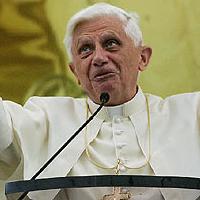
Dear Lord, what's next?  Pretending I
don't think Jews are "Christ-killers"?

The San Francisco Chronicle editorialized on A papal apology 09/19/06:

It's rare - almost unheard of - for a pope to apologize for personal remarks, yet that's what he had to do.

Given that precedent, that's probably about as much of a retraction as we'll see from Papa Ratzi.  The editorial concludes:

The Vatican's rarely used spin machine went into overdrive, producing days later a brief statement from the pope that he was "deeply sorry.'' His own thinking was nothing like the quote, he said. He wanted a "frank and sincere dialogue'' about religious differences.

It's hard to know if he'll get such a discussion going. All of the field pieces of public opinion in the Mideast rolled into position and blasted away at the episode. There were riots and effigy burnings.

Pope Benedict has plans for a November trip to Turkey, a largely Muslim nation where the Byzantine emperor once reigned. His contrite message that he was sorry for last week's speech is a first step. The upcoming visit gives him a chance to speak his mind clearly about Islam.

There are other indications, though,that Ratzinger may not think that highening Christian-Muslim religious tensions is entirely a bad thing.  For instance, Pope remarks reveal harder stance by Peter Gould BBC News 09/16/06:

One of the first signs of a toughening of the Vatican's stance came with the removal from office of Archbishop Michael Fitzgerald.

The British-born cleric ran a Vatican department that promoted dialogue with other religions. A distinguished scholar on Arab affairs, he was an acknowledged expert on the Islamic world.

The decision by Benedict XVI to remove him from his post, and send him to Egypt as papal nuncio, was widely seen as a demotion.

Some wondered about the wisdom of the move.

Father Thomas Reese, a Jesuit scholar and an authority on the workings of the Vatican, told the BBC news website of his concerns: "The Pope's worst decision so far has been the exiling of Archbishop Fitzgerald," he said in an interview in April this year.

"He was the smartest guy in the Vatican on relations with Muslims. You don't exile someone like that, you listen to them.

"If the Vatican says something dumb about Muslims, people will die in parts of Africa and churches will be burned in Indonesia, let alone what happens in the Middle East.

"It would be better for Pope Benedict to have Fitzgerald close to him."

It's important to keep in mind what is happening, though.  Juan Cole writes in Khamenei's Conspiracy Theory Links Pope to Bush's Crusade, Informed Comment blog 09/19/06

In fact, I don't know of any major mainstream Muslim leader or institution that has called for a violent response. The tiny guerrilla cells in Iraq don't count. This point is worth stressing, because of the false allegation that Muslims have in some normative way responded with violence. There has been almost none of that, despite a handful of regrettable incidents, and even the peaceful demonstrations have been tiny for a community of 1.4 billion. 150 people came out in Basra, a city of over a million.

Tina Beattie in Pope Benedict XVI and Islam: beyond words OpenDemocracy.net 09/18/06 takes a nuaned look at Ratzinger's speech, givinghim creditfor emphasizing the importance of reason in religious matters.  But she suggests that it's difficult to understand how he would have made a mistake of this kind:

 All this can be argued even before we come to the defamatory quotation which Benedict saw fit to include: the emperor is alleged to have said: "Show me just what Mohammed brought that was new, and there you will find things only evil and inhuman, such as his command to spread by the sword the faith he preached." This part of the quotation is superfluous to the pope's argument, so why did he include it?

There have been numerous ingenious attempts to argue that, as he was quoting from another source, he was not expressing his own opinion. But he does not sufficiently distance himself from the sentiments expressed in the quotation, although it has been pointed out that the German version of the speech describes this comment as "astoundingly harsh - to us surprisingly harsh", which in the English translation is rendered more mildly as "startling brusqueness". Nevertheless, some readers could justifiably be left with the sense that perhaps our contemporary Pope does not find this an entirely inaccurate description of Muhammad and his followers, so that this lecture may give us a revealing glimpse of Benedict's own prejudices.
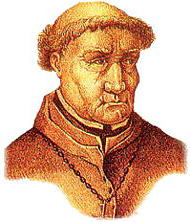
 

Tomás de Torquemada (1420-1498) who was also "harsh" toward Muslims, and Jews, too

I provided both English and German texts of the relevant passage in an earlier post.  The Vatican's official English version says, "he [the Emperor being quoted] addresses his interlocutor with a startling brusqueness".  The German version says, "wendet er sich in erstaunlich schroffer, uns überraschend schroffer Form", which Beattie has translated correctly.  Still, I agree with her characterization that one could hardly conclude from the original speech that the Pope was disagreeing with the quotation he was using.

Bradley Burston, on the other hand, writes in Ha'aretz that The Pope did us all a favor 09/19/06:

There is no way of knowing why a Holy Father would say such a thing. ...

There is no way of explaining why the Holy See, having sparked Muslim ire worldwide, and having already decided to issue an unprecedented apology, would content himself with an expression of regret worthy of the most Polish of Jewish mothers, the equivalent of "What kind of person reacts this way to things like what I said?"

Unless, somewhere inside, he meant what he said in the first place.

But I don't find his argument terribly convincing that "getting it out into the open" is wonderfully healthy:

Maybe it's time we opened up the little box of horrors inside every one of us. The one full of what we truly believe. ...

Opening the box, in this sense, does not mean simply collecting the venom in order to throw it into the face of those who vex us, annoy us, oppose us, believe in other faiths or political movements.

It does not mean, for example, firebombing churches to defend Islam from charges that it is a religion of violence. It does not mean advocating the wholesale slaughter of Muslims in order to make sure that a Holocaust does not recur.

It means opening the box so that we can examine what's in there, for good and, often, ill. Expose it, for once, to light and air.

The Pope is the leader of the largest Christian organization in the world, the Catholic Church.  He shouldn't be careless or deliberately inflamming religious tensions with pre-Reformation and pre-Enlightenment polemics against Islam and Muslims.